Prevención y defensa
Trabajamos con centros escolares y organizaciones para fomentar entornos de apoyo e inclusivos, la evaluación y el aprendizaje continuo.
What do we do with what we're learning?
CSAW brings research, evaluation, community knowledge, and lived experience together to strengthen prevention in practice. We work with schools, organizations, practitioners, and communities to develop, test, adapt, and improve approaches that support childhood safety and wellbeing.
Our prevention work ranges from community-wide strategies and professional learning to practical tools, clinical approaches, and frameworks that help people strengthen the conditions that make violence less likely.
90by30 es un esfuerzo basado en un lugar con un único objetivo aspiracional: una reducción del 90% en el abuso, la negligencia y la violencia basada en la identidad de niños y jóvenes en el condado de Lane, Oregón. 90by30 es una asociación entre la comunidad y el campus que trabaja en todo el condado de Lane, y está en estrecha colaboración con la Coalición de Prevención de la Violencia del Condado de Lane, socios multisectoriales y vecindarios. La programación de 90by30 incluye Cafés para Padres y Comunidad, el Consejo Asesor Juvenil y Estudiantes contra el Abuso Infantil.
Nuestro objetivo: Una comunidad en la que cada niño/joven del condado de Lane experimente seguridad, pertenencia y conexión, en la que cada familia tenga el apoyo y los recursos que necesita y en la que los residentes locales actúen rutinariamente para avanzar en esta visión.
Turning Learning Into Prevention
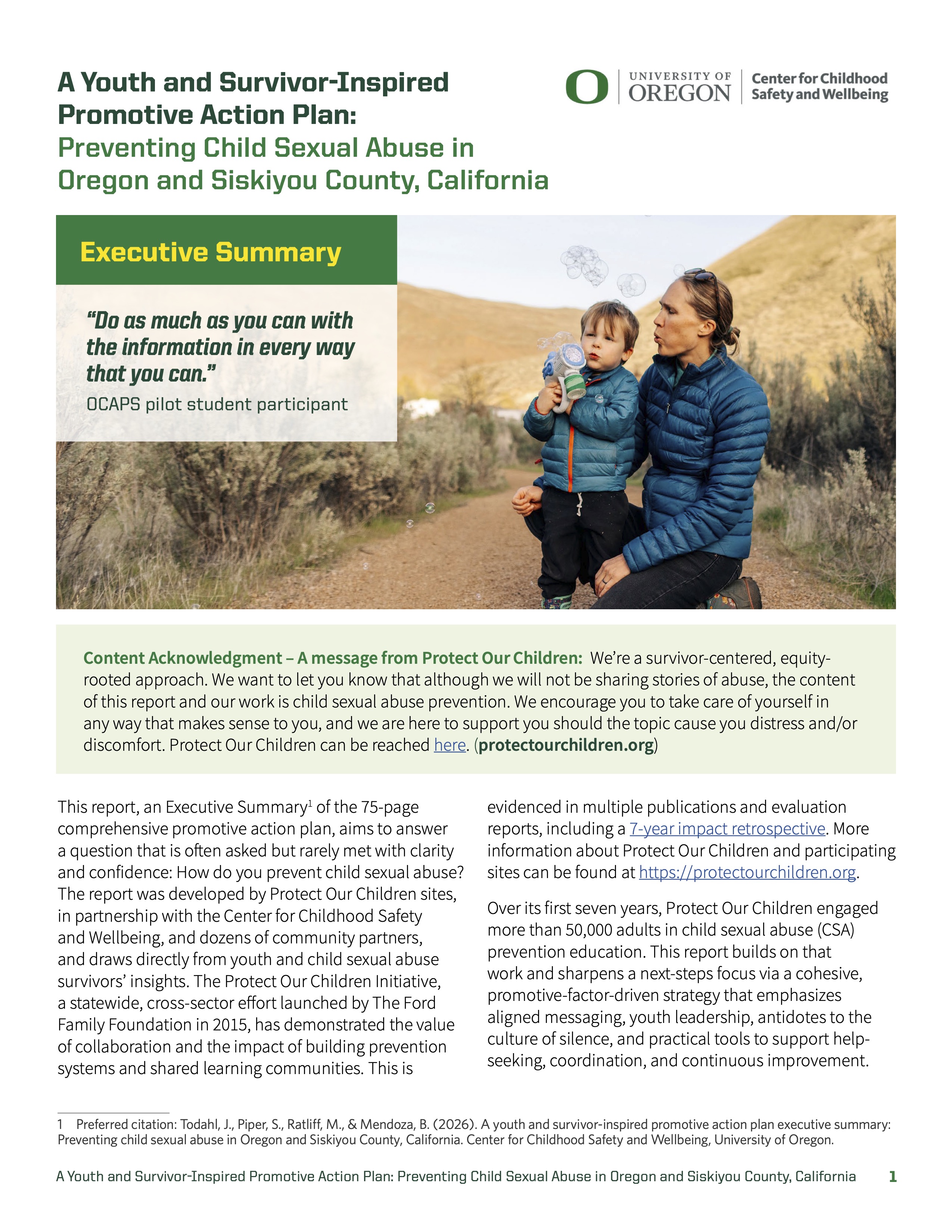
A Youth and Survivor-Inspired Promotive Action Plan
What conditions can communities deliberately strengthen to make child sexual abuse less likely and safety, trust, and belonging more likely?
CSAW’s Promotive Action Plan brings together youth and survivor insight with research and learning from prevention in practice. It identifies 10 promotive factors that communities, schools, organizations, and systems can strengthen to support child sexual abuse prevention and wellbeing.
Together, the factors address relationships and trusted support, prevention education, belonging, youth participation, responsive systems, and other conditions that help move prevention from an idea into practical action.
Prevention in Practice
Parent & Community Cafés
Parent & Community Cafés are bilingual, peer-led spaces where parents and caregivers share knowledge, build connection, and learn from one another. Inspired by the Be Strong Families Parent Café model, the Cafés create space for honest conversation about the challenges and joys of caring for children and youth while strengthening social connection and reducing isolation.
Rather than positioning outside experts as the primary source of knowledge, the Cafés draw on the strengths, experiences, and knowledge already in the room.
Participant feedback also helps shape Café content and structure over time. What parents and caregivers say is useful, what they want to explore, and how they experience the Cafés informs how the team develops and adapts the work.
The Café team has also developed and piloted Prevention Cafés, which bring research-informed tools about child, family, and community wellbeing into the same peer-led, intentionally inclusive format. The model focuses on showing up for children and youth and helping adults strengthen their roles as allies and advocates.
Parent & Community Cafés are offered in Spanish and English, with online opportunities for Lane County parents and caregivers and in-person Cafés in the Eugene and Springfield areas.

Learning That Supports Practice
Cultivate School & Community Learning Collaborative
Cultivate provides research-informed professional learning for educators, school staff, families, and community partners. Through facilitated learning, practical tools, and ready-to-use resources, participants build skills, learn from one another, and strengthen the relationships and environments that support children and youth.
Learning opportunities address topics including relationships, school climate and wellbeing, trauma foundations, positive behavior support, diversity and inclusion, instructional support, early literacy, and skills for educational assistants.
Cultivate offers both facilitated and self-paced learning, including MicroPD resources that can support professional development, group learning, and community conversations.
Clinical Practice & Interpersonal Violence
CSAW has developed research and practice guidance to help counselors, therapists, health care providers, and other professionals recognize, discuss, assess, and respond to intimate partner and sexual violence.
These resources focus on translating research into trauma-sensitive, client-centered approaches to screening, assessment, education, and clinical decision-making.
Prevention Takes Partnership
Prevention is stronger when people learn, act, and adapt together. Earlier efforts such as 90by30 and K(no)w More Lane County helped shape CSAW’s understanding of community-wide prevention, and that learning continues today.
Community engagement is part of how prevention is shaped, strengthened, and sustained.